
Understanding Modern Treatment Options for Lazy Eye in Children
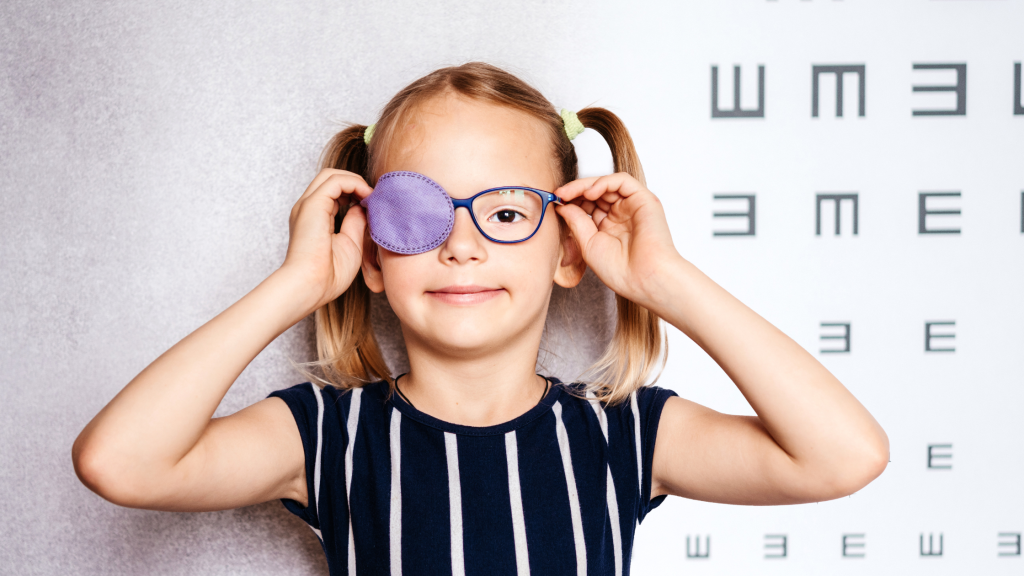
If your child has been diagnosed with amblyopia — commonly called “lazy eye” — you may have been told that patching the stronger eye is the best treatment option.
For many families, patching can feel like an uphill battle. Children often dislike wearing the patch, it can interfere with school or play, and parents are left feeling frustrated or guilty when it becomes difficult to maintain consistently.
But here’s something important many parents are never told:
Amblyopia is not simply an eye problem. It is primarily a brain and visual processing problem — and that changes how we approach treatment.
At Eyes of New Mexico Family Optometry, we help families better understand how amblyopia affects the connection between the eyes and the brain, and how modern vision therapy approaches can support stronger binocular vision and long-term visual function.
Amblyopia treatment may include binocular vision therapy and other approaches beyond traditional eye patching.
What Is Amblyopia?
Amblyopia occurs when the brain begins suppressing or ignoring input from one eye because the two eyes are not working together efficiently.
Over time, the “ignored” eye falls behind in visual development. The eye itself is often healthy, but the communication between the eye and the brain becomes disrupted.
That’s why amblyopia is best understood as a neurological and binocular vision condition, not simply a weak eye.
Children with amblyopia may experience:
- Reduced vision in one eye
- Poor depth perception
- Difficulty with eye teaming
- Reading challenges
- Trouble tracking moving objects
- Reduced sports performance
- Eye strain or visual fatigue
Why Traditional Eye Patching Has Limitations
Eye patching works by covering the stronger eye to force the weaker eye to work independently.
In some cases, patching can improve visual acuity in the weaker eye. However, it often does not address the underlying issue: helping the brain learn how to use both eyes together.
And in real life, we rarely use only one eye at a time.
Most of the visual system is designed for binocular vision — meaning both eyes should work together as a team to create depth perception, coordination, balance, and comfortable vision.
Because patching isolates one eye instead of improving teamwork between both eyes, some children may regress once patching stops.
This is why many modern developmental and functional optometrists now combine or replace patching with binocular vision therapy approaches.
What Research Says About Amblyopia and the Brain
Research has helped us better understand how amblyopia affects the visual cortex — the part of the brain responsible for processing vision.
In a landmark animal study, Crawford and Harwerth (2004) examined monkeys with early binocular vision problems and found that the areas of the visual cortex devoted to the weaker eye were reduced compared to the stronger eye.
More importantly, the study reinforced something critical:
Under normal development, most visual brain cells are designed to receive information from both eyes together.
The brain is built for binocular teamwork.
When one eye becomes suppressed, it is often because the brain has learned an unhealthy adaptation — not because the eye itself is incapable of functioning.Reference:
Crawford, M. L. J., & Harwerth, R. S. (2004). Ocular dominance column width and contrast sensitivity in monkeys reared with strabismus or anisometropia. Investigative Ophthalmology & Visual Science, 45(9), 3036–3042.
A Modern Approach to Amblyopia Treatment
Modern amblyopia therapy increasingly focuses on helping the brain use both eyes together instead of isolating one eye.
Through customized vision therapy activities, therapeutic lenses, prisms, filters, and binocular training programs, children can learn to reduce suppression and improve visual integration between the eyes.
This type of binocular vision therapy may help improve:
- Eye teaming
- Depth perception
- Reading fluency
- Visual attention
- Hand-eye coordination
- Sports performance
- Visual comfort and endurance
Most importantly, it helps children develop visual skills that support daily life, learning, confidence, and overall quality of life.
At Eyes of New Mexico Family Optometry, our approach focuses on evaluating how the eyes and brain function together so treatment can address the root cause of visual difficulties — not just the symptoms.
Can Older Children Still Benefit from Vision Therapy?
One of the most common misconceptions about amblyopia is that treatment only works before age 7.
We now know that the brain remains adaptable through neuroplasticity far beyond early childhood.
Older children, teenagers, and even adults can often improve visual function and binocular coordination through properly designed vision therapy programs.
While earlier intervention is ideal, it is rarely “too late” to strengthen visual processing and binocular vision skills.
Helping Children Build Stronger Vision and Confidence
If your child is struggling with amblyopia, know this: patching is not the only option.
By understanding amblyopia as a brain-based binocular vision condition, we can focus on helping both eyes work together more efficiently — supporting not only clearer vision, but also confidence, comfort, learning, and daily performance.
When we strengthen the connection between the eyes and the brain, we help children do far more than see better.
We help them engage with the world more comfortably and confidently.
FAQs About Amblyopia and Vision Therapy
Does my child still need patching?
Sometimes patching may still be recommended as part of treatment. However, many children benefit most from therapies that also train both eyes to work together.
What is binocular vision therapy?
Binocular vision therapy focuses on improving how the eyes and brain coordinate together instead of training one eye in isolation.
Can vision therapy help with reading and attention?
Yes. Many children with amblyopia or binocular vision problems also experience reading fatigue, poor tracking, attention difficulties, or visual discomfort that may improve with therapy.
Where can I find amblyopia treatment in Albuquerque?
At Eyes of New Mexico Family Optometry, we provide functional optometry evaluations and vision therapy programs designed to support binocular vision and visual development.